Why "Open-Ended" Toys Are the Best Money You'll Spend This Holiday Season
By Kibtoy | [Month Day, Year]
Every holiday season, the same thing happens.
Parents spend weeks hunting down the "it" toy—the one every kid on TikTok is unboxing, the one that sells out by Black Friday, the one your child has circled seventeen times in the catalog. And then, sometime around January 3rd, it happens: the toy gets played with for twenty minutes, shoved into a bin, and never touched again.
Meanwhile, the simple wooden blocks your kid got from grandma? Those are still on the living room floor in March.
There's a reason for that—and it's the same reason toy experts have been quietly recommending open-ended toys for decades. This holiday season, we're making the case for why they deserve a spot under your tree (and why they might be the smartest toy purchase you make all year).
What Exactly Is an Open-Ended Toy?
An open-ended toy is any toy that doesn't come with a predetermined outcome. There's no "correct" way to play with it, no instructions, no finish line.
A puzzle has one solution. A coloring book has one picture. But a set of wooden blocks? A stack of felt shapes? A bin of loose parts? Those can become a castle, a rocket ship, a zoo, a city, a birthday cake—whatever your child's imagination decides that day.
The defining features are simple:
· No single "right" way to play
· No batteries, no screens, no app
· Grows with your child (a 2-year-old stacks them; a 7-year-old builds elaborate worlds)
· Encourages child-led play rather than parent-directed or toy-directed play
Why Pediatricians and Educators Keep Pushing Them
This isn't just a parenting trend. The American Academy of Pediatrics has long emphasized that unstructured, imaginative play is critical for healthy brain development—particularly for executive function, language, and social-emotional skills.
Open-ended toys are basically the hardware for that kind of play.
When a child builds a "spaceship" out of blocks, they're doing far more than playing. They're:
· Planning and problem-solving (how do I make this tall part stay up?)
· Practicing narrative thinking (where is the spaceship going? who's on it?)
· Developing fine motor control (stacking, balancing, connecting)
· Learning to tolerate frustration (the tower falls, they rebuild)
· Playing collaboratively (negotiating with a sibling over the same pieces)
A toy that does all the entertaining for a child—press a button, watch a light flash—skips all of that. The toy is doing the playing. The child is just watching.
The Economics Make Sense Too
Here's the practical argument that rarely gets made: open-ended toys have a much longer shelf life.
A character toy tied to a movie? Obsolete the moment the sequel flops. A battery-operated gadget? Dead in a month when the batteries run out and nobody remembers to buy more.
But a good set of building blocks, a play kitchen, a collection of loose parts, a set of magnetic tiles—these get played with for years, across multiple developmental stages, by multiple children. When you divide the cost by the hours of actual play, the math is unbeatable.
If you're a parent trying to be intentional about holiday spending—buying fewer, better things instead of a mountain of plastic—open-ended toys are the category that rewards that approach.
Our Favorite Open-Ended Categories This Season
Building Sets (Blocks, Tiles, Connectors)
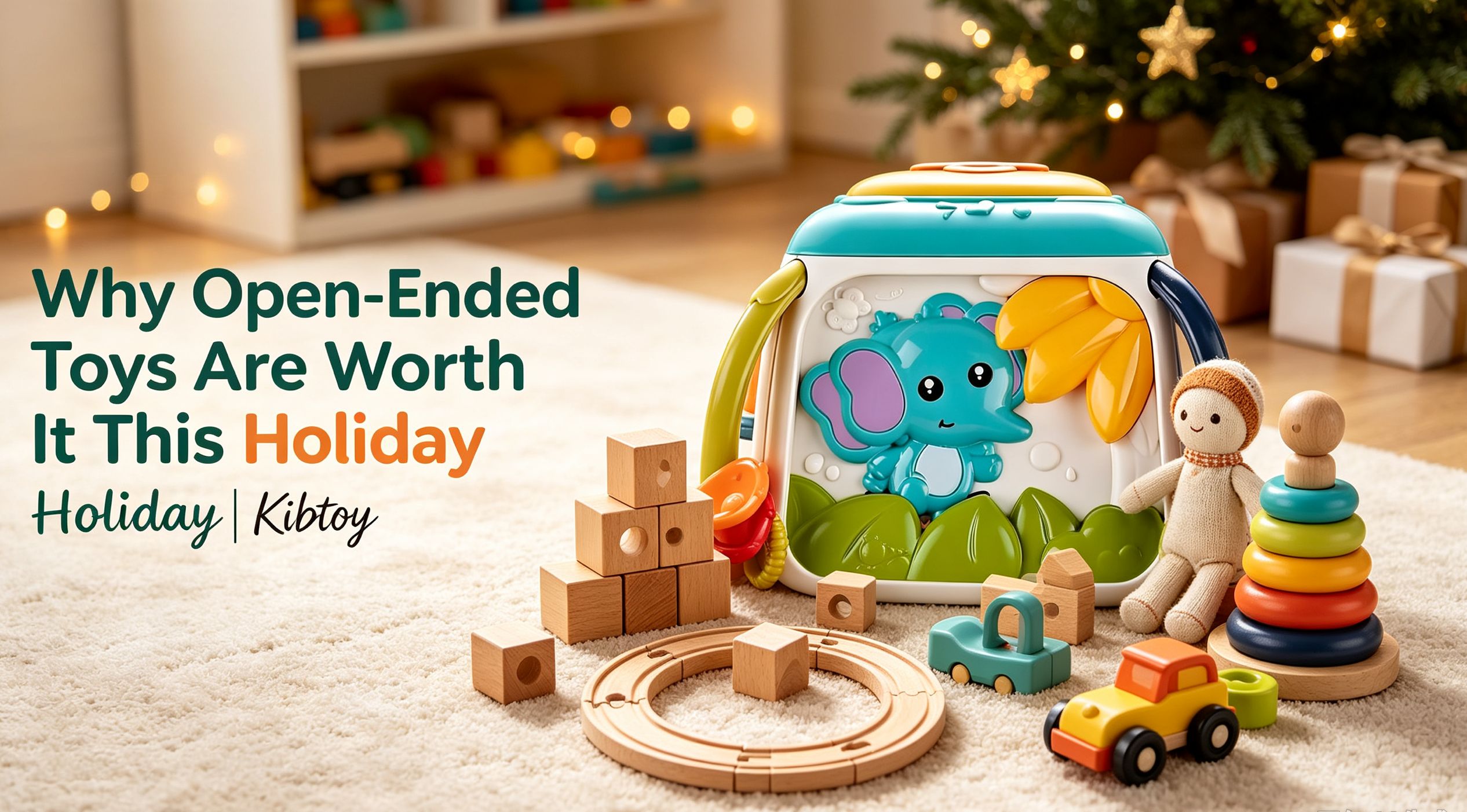
The granddaddy of open-ended play. Wooden blocks, magnetic tiles, and connector sets are endlessly reconfigurable. Look for sets with simple, uniform pieces rather than themed kits—the plainer the pieces, the more they can become.
Loose Parts & Small Worlds
Baskets of wooden figures, felt shapes, peg dolls, and natural materials. These are the raw ingredients for storytelling and small-world play. They pair with everything and take up almost no space.
Art & Making Materials
Blank paper, chunky crayons, clay, washi tape, safe scissors. Art supplies are the ultimate open-ended toy—every session produces something new, and the process matters more than the product.
Pretend Play Props
Play food, toy tools, doctor kits, dress-up pieces. Pretend play is where kids rehearse the adult world, and the simpler the props, the more the imagination has to fill in.
Sensory & Tactile Toys
Playdough, sensory bins, water tables, kinetic sand. These support regulation and exploration—and they're endlessly repeatable.
A Quick Word on "Screen-Free" (Without the Guilt)
We're not here to tell you screens are evil. But if you're looking to add more hands-on, child-led play into your home this season, open-ended toys are the easiest on-ramp. They don't require a setup, a subscription, or a charging cable. They just require a kid and a little bit of space.
Final Thoughts: Buy Fewer, Better Toys
The holiday season is loud. The marketing is relentless. The pressure to buy the "hot toy" is real.
But the toys your kids will remember aren't usually the ones that made the most noise in the commercial. They're the ones that let them make something—a world, a story, a mess, a memory.
This year, consider trading a pile of single-purpose toys for a few really good open-ended ones. Your living room will thank you. Your wallet will thank you. And honestly? Your kid probably will too—even if they don't know it yet.
— The Kibtoy Team
Shop Kibtoy's curated collection of open-ended, screen-free toys—built to be played with for years, not weeks.